
Foundation
Get an overview.
Learn the basics and use a checklist to identify what matters in your area.
FOR PEOPLE WHO TAKE RESPONSIBILITY
Learning for people responsible for security, crisis management and AI. Develop solutions to tasks from your organisation and test how they work.

Learn the basics and use a checklist to identify what matters in your area.
KR eCampus
Put knowledge into practice, develop your ideas and learn together in live seminars. Discover learning on eCampus.
Competency levels
Foundation
Learn the basics and use a checklist to identify what matters in your area.
Advanced
Work on a specific task from your organisation, such as a continuity procedure, an audit or an AI workflow.
Expert
Plan a wider initiative and work with management to develop the procedures, working materials or tools it needs.
KR eCampus
Explore the topics and find a course for the task you face. Courses are in development and are not yet bookable.

Design and try an AI-supported workflow for a task in your team. Work through a checklist and two requests, then keep the checklist and worked examples for later suitable tasks.
View details
Build an AI-supported tool to check records of periodic access rights reviews. It compares the records with an internal policy, flags missing or outdated evidence and checks newly received records again. Configure the workflow, test error cases and keep your configuration.
View details
Prepare an AI management system and add checks for an AI service to an existing approval process. Work through the service’s introduction and a later provider update.
View details
How is an AI application used in a management system, and what findings can the available evidence support? Develop an audit assignment with questions and a list of suitable evidence for your area.
View details
If customers can increasingly produce reports themselves using AI, a provider must reconsider its business. Should it offer existing reports more cheaply or develop a new service with ongoing expert-reviewed insights? Compare the options and test a work sample for the new service.
View details
A service agent promises high value but needs data approval that is not yet available and the same scarce specialist as other initiatives. An internal search tool can be tried in a limited way with approved documents. Decide which AI initiative should start first.
View details
A business unit wants to add a document source to an existing AI search tool. Who checks data access, who approves the change and who rolls it back if results are wrong? Develop a change procedure that assigns these tasks and handovers.
View details
Build a spreadsheet for an AI investment and compare the current procedure with an AI-supported alternative. Include data preparation, review, rework and ongoing costs.
View details
An AI tool is meant to sort incoming requests. Employees demonstrate that urgent cases are classified as routine and no timely second review is in place. Assess their evidence and change the workflow before planning further rollout.
View details
An AI report claims high usage and a successful rollout. A further analysis reveals repeated attempts after failures and no time saving in an important business area. What should your board or executive team ask next? Develop a question guide that you can use for later AI reports.
View details
Compare two AI providers using the same professional questions and reference answers. A strong general benchmark is insufficient if answers omit information needed for your particular task. Develop your requirements catalogue further for your own procurement.
View details
An AI agent can sort purchase-order discrepancies and prepare a draft for a caseworker. Set up an example agent, run it on practice data and observe how it handles the task.
View details
A policy requires approval before an AI model is used in production. In the audit case, the operating log shows use two weeks before the recorded approval. Compare the events and investigate what the discrepancy establishes. Formulate a finding and record your work in an audit file.
View details
An AI system sorts applications. An incorrect rejection can leave an eligible application unprocessed. Test whether a second professional review catches that error before dispatch, and prepare a control sheet for your own use case.
View details
Redesign a business process within your area of responsibility. First map the current workflow and identify steps that could be removed or simplified without AI. Then design an AI-supported alternative, specifying who decides, checks the results and handles exceptions.
View details
Assign business ownership, maintenance and technical provision for a data flow. In a case, compare whether the data supports broad capacity planning or decisions about individuals. Determine who decides on correction or restrictions on use.
View details
Develop a concept for an AI product or service and test whether customer value and costs fit together. Define the customer task, compare an alternative and specify data needs, human review and operational responsibility.
View details
Assess whether an AI initiative delivers its promised value and whether it should be scaled, adapted or stopped. Define a baseline and suitable indicators, separating available measurements from estimates and assumptions.
View details
When AI drafts responses, the work of the people checking and approving them changes too. Review three drafts and develop a plan for allocating tasks, participation and training in the affected area.
View details
Design a process for AI incidents, from reporting and limiting use through business review and a possible restart. Follow up decisions already influenced by an incorrect output.
View details
Review an AI-supported analysis before it informs a management decision. Check its claims against source data, examine assumptions and counterarguments, and prepare your own recommendation with outstanding questions.
View details
AI is proposed to sort online applications. How can people without internet access still reach the service, and who makes the substantive decision? Design an administrative workflow that brings together AI support, human processing and access.
View details
Plan an AI pilot using a customer-service case from a financial-services organisation. Work out who provides the required evidence, when an approval decision is needed and which preparatory tasks can already begin.
View details
A circulated clip may be manipulated or may show a genuine statement. Prepare an initial response to a suspected deepfake or disinformation incident, separating established facts from open questions.
View details
Set up an AI team with at least three distinct roles for a workflow. Define handovers, information access and human decision rights, then test the workflow. A record shows errors and changes to make before further use.
View details
Use AI as a practical tool in your cyber defence. In three labs, you learn to prioritise vulnerabilities, develop detection rules and support incident response. You identify concrete applications for your security team.
View details
Disconnecting an affected system immediately can limit the spread of a cyber incident, but it also interrupts a critical service. In this course, you decide how to proceed during the first 120 minutes: define the escalation route, prepare a situation picture and issue initial instructions.
View details
A crisis management team needs a clear mandate, reachable people in key roles and defined decision routes. Draft crisis management arrangements for your organisation and examine them against an escalation case. The result is a crisis management team charter for discussion with senior management.
View details
Prepare a crisis management exercise for your organisation or using a course case. Develop a scenario, write the injects and define what observers should look for. Work through an exercise sequence and revise your inject and evaluation plan for further preparation.
View details
Turn findings from an incident, exercise or process failure into practical actions. Record tasks, owners, deadlines and effectiveness checks on an action board. Using your own case or a course case, you examine whether a measure has the intended effect.
View details
When a client faces a crisis, a communications agency needs to know what it will do and who makes decisions. Develop a mandate template covering approvals and handovers, then test the arrangements in a time-sensitive case. Use it to prepare a discussion with client management and specialists.
View details
When an incident becomes public, communication and leadership need coordinated statements. Decide whom to inform and who approves the message, then draft an initial statement with confirmed information, open questions and a time for the next update.
View details
Crisis leaders must make and explain decisions with incomplete information. Work through a leadership decision from your organisation or a course case, compare options and write instructions. Your guide records who decides, which counterarguments matter and when to review the decision.
View details
A crisis team needs a basis for decisions even when reports conflict. Prepare a situation report with a decision log and clarification requests. Record sources, uncertainty and open questions so the basis for decisions and later corrections remains clear.
View details
How well is your area prepared for a crisis? Review records on crisis leadership, decisions and communication using themes from ISO 22361. Choose priority improvements and prepare to discuss them with management.
View details
Create an alerting and handover procedure for a site and work through a night-time emergency report. Establish who receives the report, who takes over if the first contact is unavailable and what information should be passed to external responders. Use your site’s arrangements or a fictional case.
View details
Prepare to facilitate a tabletop exercise: write opening questions, plan interventions and create a guide for the debrief.
View details
After a cyberattack, several business processes need to resume. Develop a recovery plan with a sequence, release conditions and fallback routes. In the case, revise the sequence when data has been manipulated.
View details
An extortion message puts your organisation under time pressure. Prepare initial protective instructions, identify specialist contacts and escalation routes, and decide what information senior management needs.
View details
Which service must your organisation sustain under pressure? Examine what that service depends on, what preparations already exist and where improvements are needed. Develop a resilience diagnosis, a 90-day plan for your area and a brief for the next management decision.
View details
What needs to recover first after a disruption? You examine the services in an area and explain the recovery order to colleagues in operations, IT and finance. You create a business impact analysis for your organisation or a course case.
View details
Create a first continuity plan for a critical process in your organisation. Define the minimum service needed during a disruption, its dependencies and the steps for recovery. The plan records responsibilities, assumptions and open decisions for discussion with the process owner.
View details
Which suppliers and inputs are essential to your most important services? You examine those dependencies and decide where alternatives or stock are needed. The result is a list of the most critical dependencies and options for continuing when a supplier fails.
View details
What does your area need to maintain important services during disruption? Use a resilience checklist to examine resources and deputies, identify gaps and organise initial improvements. Keep the completed checklist to review preparedness again later.
View details
Identify risks in your area and prepare management decisions on whether to treat or accept them. Your risk register sets out causes and consequences; your treatment plan records responsibilities, resources and decisions still needed.
View details
How might a decision change if the future develops differently from what you expect? Build scenarios for a planning question from your organisation or a course case and compare your options. Define early indicators to show which developments to monitor and when to revisit the decision.
View details
Prepare the implementation of a business continuity management system. Develop an implementation pack with tasks, owners and initial test instructions. Use the results of a fallback-site test to identify gaps and schedule corrective work.
View details
Plan your organisation’s business continuity programme: decide which goals come first, who will do the work and what resources are available. You also plan how to involve staff and review progress. The result is an annual programme with assignments, staff hours and a procedure for a rehearsal.
View details
Which continuity option meets the required service level and what does it cost? Compare options in an editable calculation covering minimum service, lead time, initial and recurring costs and shared dependencies. You can add later offers using the same criteria.
View details
IT recovery objectives need to match business requirements and provider capabilities. Develop a recovery plan for one IT service: what comes first, what does the service depend on, who approves its use and how will recovery be tested? Use it to prepare discussions with IT leadership, business teams and continuity management.
View details
A component is in stock for only eight more weeks. A second supplier needs twelve weeks to qualify and sources its input from the same region. Assess what action is needed before a potential shortage and whether the substitute actually reduces the dependency.
View details
Work through a checklist for cybersecurity reports to your management body. Check which statements are supported by evidence, where information is missing and which follow-up actions are needed. Adapt the checklist to your organisation.
View details
The Digital Operational Resilience Act (DORA) sets requirements for digital operational resilience in the EU financial sector. Complete a task checklist for your area to identify internal responsibilities, a supplier’s contribution and contacts for unresolved questions.
View details
A report claims that 100 per cent of recovery tests succeeded. On closer inspection, only a low-criticality system was tested. Assess what the evidence supports and plan how to test the critical service and address a finding.
View details
A contract permits exit from an ICT service within three months. Data export takes four months and a replacement provider needs five. Plan how the minimum service can be maintained during the transition.
View details
Two areas report the same recovery status. In one, the test worked but its record is missing; in the other, a plan exists but the test failed. Distinguish the gaps and record the tasks and dependencies for NIS2 implementation on an action board.
View details
A service fails at 8:00. The cause and scope are still unclear, and the case requires an internal handover by 10:00. Prepare it with confirmed information and open questions, and identify who makes the provisional decision.
View details
During a power outage, a water service needs a contractor's mobile pumps. The contractor also serves other customers and needs water for its own operations. Determine what minimum service remains possible under those conditions.
View details
In the course case, a water service’s pumps need an external backup supply during a power outage. Work out when continued operation remains manageable and when an orderly shutdown is needed. Use the case to develop a resilience plan for a site or service area.
View details
Two fallback sites appear independent but receive power through the same substation. Flooding or a technical failure could affect both. Examine shared dependencies and compare ways to address them. Use your analysis for further work on the service in your organisation.
View details
A critical infrastructure review has a policy, records and certificate, but none shows that the control operated at the site under review. Establish what the documents support and request the missing evidence.
View details
Plan the start of an information security management system (ISMS) for a defined area. Establish its scope, protection objectives and roles, and record initial risks and actions. You can take the resulting concept forward with the people responsible in your organisation.
View details
Plan the annual information security programme for your area: which objectives and risks come first, and what actions and resources are needed? A management review template helps you present the decisions and supporting evidence to leadership.
View details
An internal ISMS audit should give management a reliable basis for decisions on corrective action and further review. Plan an audit, assess different evidence and write findings. Build your audit programme, audit plan and template for the management report.
View details
Assess the physical security risks at a site and prepare an action plan. You decide which measures to prioritise and consider how they can be implemented. The plan supports internal review, commissioning and budgeting. Work with your organisation or a course case.
View details
When digital and physical disruptions happen together, security, IT and crisis leaders need to work together. For one site, you determine who assesses reports, coordinates protective measures and decides when priorities conflict.
View details
Assess an ICT supplier and decide what evidence your organisation needs for the service, who checks it and what happens if it is missing.
View details
An older controller can only be updated during a production shutdown. An immediate patch would stop the plant for longer. Work through the change request, decide how to handle the risk until the maintenance window and record the time-limited exception for follow-up.
View details
Unusual network traffic affects a production controller. Disconnecting it immediately could stop the process in an uncontrolled way. Compare response options and prepare a guide for decisions and restart.
View details
One person can change supplier data and authorise payments alone. Examine how to prevent an unauthorised change followed by payment.
View details
A night-shift employee reports a threat, but the designated HR contact is unavailable until morning. Develop a reporting route with reachable contacts and a procedure for immediate danger, so protection and support can be organised at night.
View details
Two employees travel to the same country. One visits an accessible city site during the day; the other works at night in a remote location without reliable communications. Decide what conditions and support each trip needs, and prepare a checklist you can adapt for future trips.
View details
A delegation trip requires continuous local protection and a contact who is available at all times. One provider offers references and extra technology but cannot commit to local support. Assess proposals against mandatory services first.
View details
A business unit wants to launch a new service despite a known failure dependency and assigns the risk to security. The security function controls neither service scope nor budget. Establish who owns the business risk and what protection security can provide, then develop a service catalogue for work with business leaders.
View details
During a security incident at an energy utility, operations, IT/OT and management need to know who decides and when to involve others. Develop an incident plan for a supply area, including responsibilities and deputies, for discussion with management.
View details
Information security in healthcare must account for consequences for care and operations. For one care process, you assess information risks and decide which safeguards are needed, who is responsible and when to review them. Your plan supports discussion between senior leadership, clinical leads and information security.
View details
In the course case, heavy rain cuts a site’s electricity supply while the building remains intact. Compare protection measures and backup power, then develop a procedure for maintaining the service.
View details
Plan limited emergency operation for a health service: what care can the available teams maintain, and when must another partner take over? Take the plan forward with the parties involved.
View details
Plan a production restart: determine the order in which lines restart, when maintenance is needed and which quality approvals must be in place.
View details
Plan time-limited emergency operation of a utility service. Using your own case or an example, determine how long available staff and backup capacity can support it and when escalation is needed.
View details
When an administrative system fails, people still need access to the service. Design a limited alternative route and plan how cases will later return to the system.
View details
Use a disruption scenario to assess whether a critical service could resume within its agreed tolerance. Consider when work actually resumes as well as when the system returns.
View details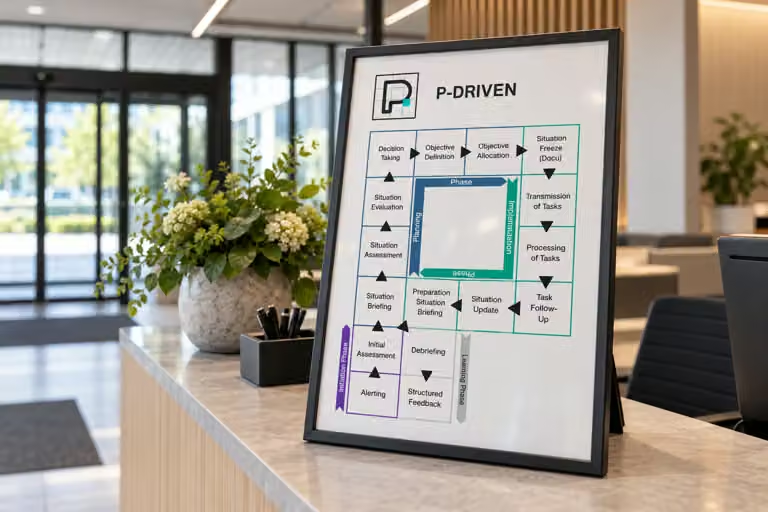
Assess whether P-DRIVEN fits a situation from your organisation or an example case. Complete a suitability checklist: What requires several areas to work together? Who has authority to make the substantive decision, and who guides the process?
View details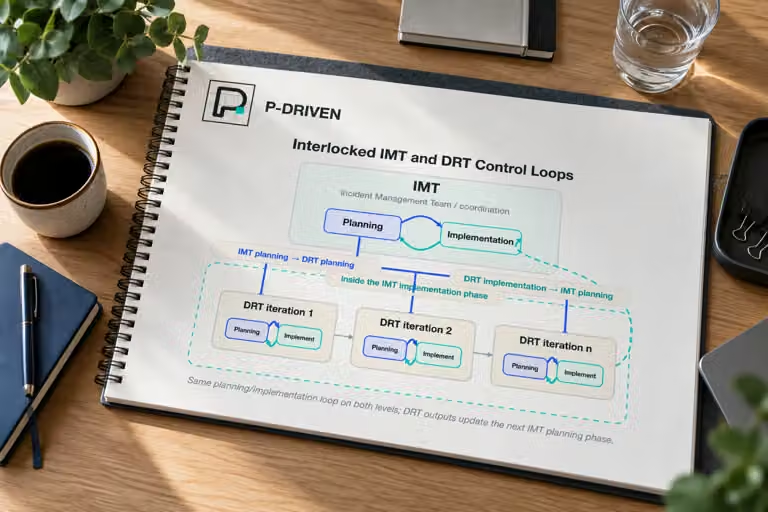
When preparing a crisis exercise, you need to decide who makes substantive decisions and who guides the process. P-DRIVEN Foundation introduces four phases and 16 steps. Assign the roles for a case and prepare an initial exercise.
View details
Prepare your role in a P-DRIVEN cycle, from activation through decisions to handover. Define what you contribute, the authority you have and how you respond when the situation changes.
View details
Guide a team through a P-DRIVEN cycle while the Owner makes the substantive decisions. In observed exercises, you receive feedback and improve your approach. Practical assessment, oral review and accepted references are separate requirements for the qualification.
View details
Plan and teach a P-DRIVEN crisis management session, then improve it using feedback from an observed teaching demonstration.
View details
Prepare a situation briefing, compare options and make a decision as the Owner. If the Facilitator challenges a departure from the P-DRIVEN process, explain and record how you respond.
View details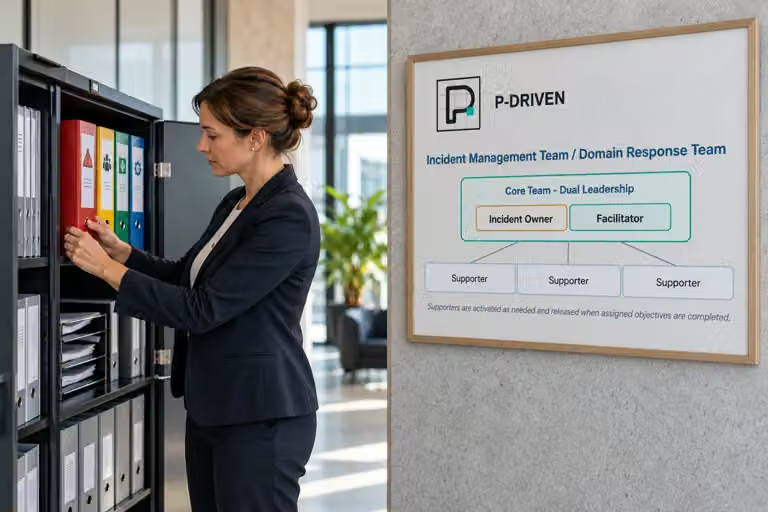
Plan how to introduce P-DRIVEN into your existing crisis arrangements. Clarify roles and authority and develop a 90-day plan covering preparation and initial exercises.
View details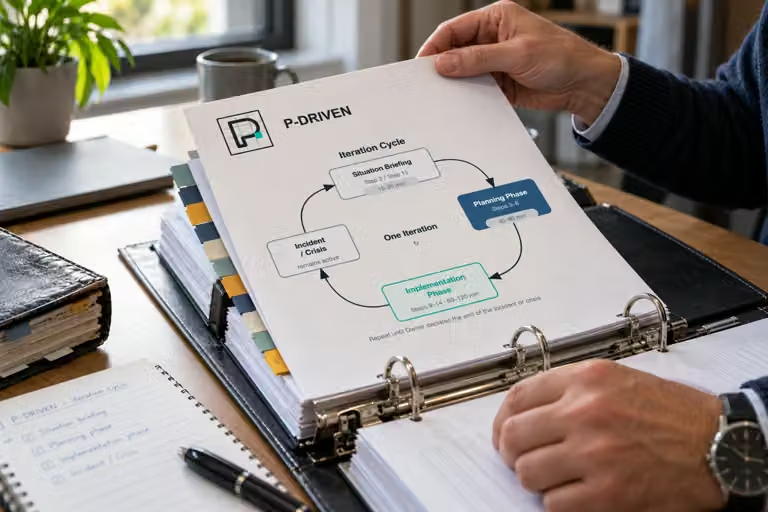
Compare your P-DRIVEN practice with the current Guide and the requirements of your role. Identify changes to your workflow, prepare your practice evidence and try the changes. Planned renewal also includes the review required for your role.
View details
Your leadership team connects a concrete strategic decision with the development of initial AI tools. You assess options, test work processes and agree which decisions remain with people, which tasks AI may perform and what needs to happen over the next 90 days.
View details
Together, set up an AI team for an organisational process. Allocate tasks to roles, design handovers and establish human decision rights. Test and improve the workflow using agreed cases to inform a decision on further use.
View details
Crisis leadership means deciding with an incomplete picture and against the clock. Over three days you work through a crisis situation from your own organisation, make individual decisions and explain your choices, clarify roles in the leadership team and derive an improvement plan for your organisation.
View details
Organisational resilience depends on how leadership, processes, resources and cooperation interact. Your leadership team examines a part of its organisation, bases its assessment of strengths and gaps on concrete observations and develops a prioritised action plan with responsibilities and initial steps for the next 90 days.
View details
Examine a business process from your area of responsibility, assess the consequences of interruption and develop a recovery plan. Agree priorities and resources with other participants and revise your contribution after feedback from another professional role.
View details
Several AI initiatives compete for budget and specialist staff. Your leadership team compares them, allocates resources and reorders the portfolio when conditions change. Keep an editable board with follow-up assignments, owners and dates for further work.
View details
AI governance needs clear decision rights for business owners, security, operations and other control functions. You jointly design approval and ongoing controls for an AI use case. Using a case, you practise reviewing results, handling deviations and repeating checks after changes.
View detailsNo matching courses found. Try another search term or change the filters.
THE KR LEARNING APPROACH
Bring a task from your organisation, develop a solution and test it during the course. You can also use a case provided in the course.
Expert · In person / In-house
Five days for five to ten people from one organisation’s leadership team. Develop an AI strategy, try out tools and agree which initiatives to pursue over the next 90 days.
Enquire about this course Talk to us about what your leadership team needs. Room to grow.
GOOD TO KNOW
Key questions
before choosing a course.
No. Choose according to your prior knowledge and the prerequisites for the course.
Foundation covers the basics. Advanced focuses on a specific task. At Expert level, you bring several tasks and responsibilities together in a wider initiative.
We are developing self-study courses, classroom workshops and in-house programmes. Each course description shows its planned format.
Courses are still in development. If a topic interests you, get in touch. We will discuss the right format and next steps with you.